.avif)
.avif)
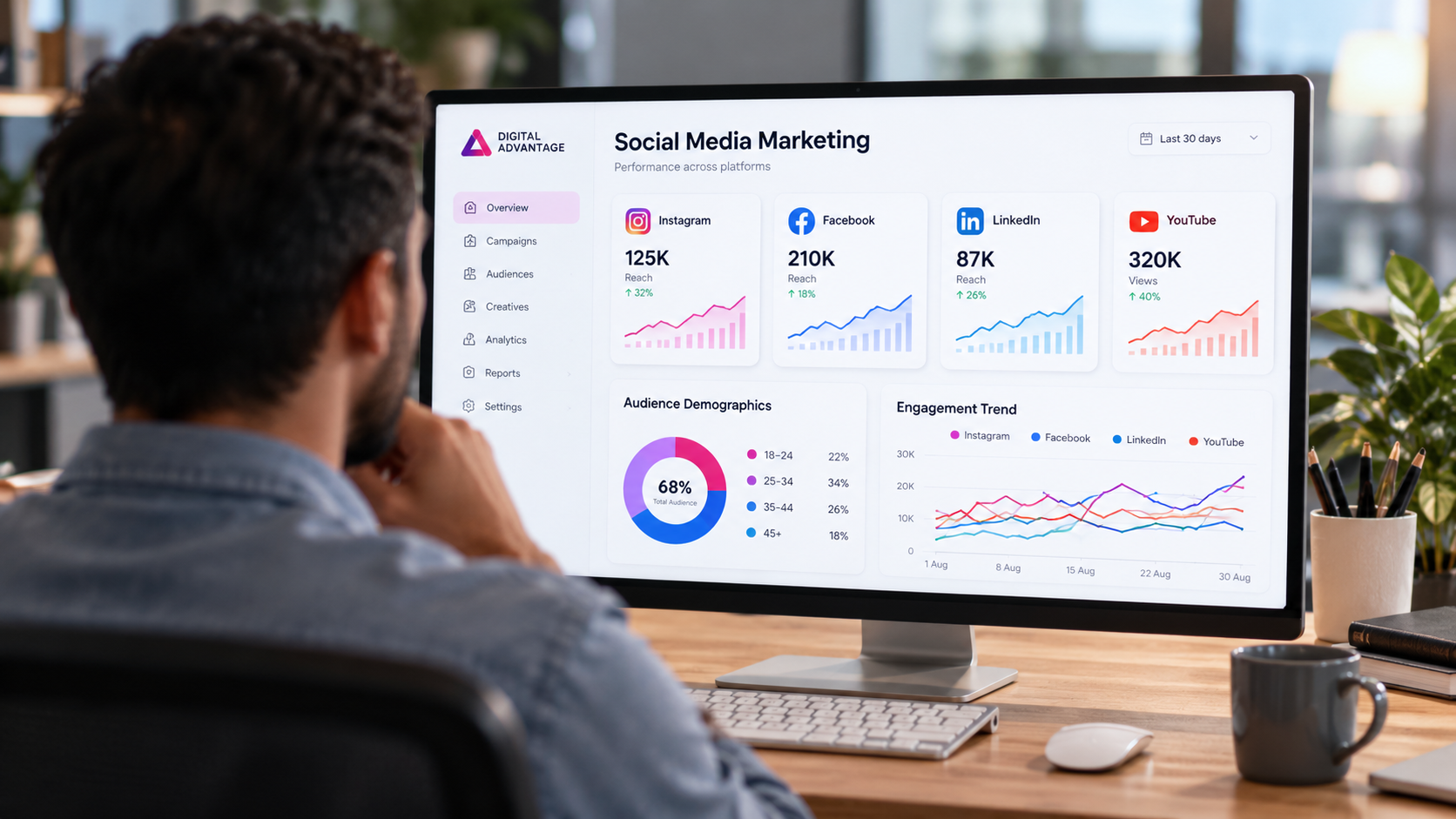
Most small businesses do not have a posting problem. They have a system problem - content, paid distribution, and conversion paths that never connect to each other or to revenue. Social media marketing for a small business is the practice of using organic content, paid social advertising, and community management to generate awareness, enquiries, and customers - measured against commercial outcomes such as leads, cost per lead, and conversion rate rather than follower counts alone.
Social media is already a mainstream business channel in India. In CPA Australia's 2025–26 India small business survey, only 10% of respondents said their business did not use social media in 2025. The question is no longer whether to participate. It is how to connect content, customer conversations, paid distribution, and measurable business outcomes - and whether to run that system in-house, with a freelancer, or with a social media agency.
Key takeaways
- Social media works as a revenue system, not a posting schedule - content, paid distribution, and conversion paths must connect.
- Choose platforms by buyer journey and content capacity, not follower potential or popularity.
- A sustainable content calendar beats an ambitious publishing plan that collapses in month two.
- Organic social reveals customer questions; paid social scales messages that already show promise.
- Measure forward from engagement to leads, lead quality, CPL, CAC, and conversion rate - not likes alone.
- Hire a social media agency when consistency, paid campaign management, and reporting exceed internal capacity.
What social media should actually achieve for a small business
Social media should do six commercial jobs: build awareness, establish trust, create demand before someone is ready to buy, capture enquiries, support conversion into bookings or sales, and retain existing customers. Each job has a different measurement. Treating all six as one "engagement" number is why most small business social reporting fails to inform any decision.
Brand awareness and credibility
Prospects may check social profiles before they call. A dormant account, unanswered comments, or three-year-old posts can create doubt at exactly the moment someone is deciding whether you are a real, active business. Measure this through reach, profile visits, and branded search movement.
Demand and lead generation
Social content can create interest before a prospect is ready to contact sales. That interest only becomes commercially useful when a conversion path exists - a lead form, a landing page, a call button, or a message thread. Measure enquiries, leads, and qualified leads, not post reach alone. If enquiry volume is the constraint, our guide to PPC lead generation management tied to booked revenue covers how leads should be routed and worked.
Social proof and customer trust
Testimonials, customer photos, before-and-after work, reviews, and staff content can provide evidence that brand copy cannot. Saves, shares, and inbound questions can be useful signals here because they may indicate that someone is evaluating rather than simply scrolling.
Customer conversations and retention
Comments and DMs are a service and sales channel. Questions about price, availability, location, and process can arrive daily. How quickly and usefully those are answered should be monitored alongside whether enquiries become customers and whether existing customers return.
One caveat worth stating plainly: social media may not close a high-consideration purchase on its own, and reporting is directional rather than complete. Platform dashboards can miss or model parts of a journey where consent is withheld, the conversion happens offline, multiple devices are involved, or the sales cycle is long. Google's own documentation explains that conversion modelling is used precisely because some conversions cannot be directly observed due to privacy and technical limitations.
Social media is a revenue system, not a posting schedule
The gap between businesses that get customers from social media and businesses that get compliments is structural. One group runs a loop. The other runs a publishing calendar.
The loop looks like this:
- Customer insight - the questions, objections, and language of real buyers.
- Content and creative - assets built from those questions, not from trends.
- Platform role - a defined job for each channel, not presence everywhere.
- Organic distribution - consistent publishing and community interaction.
- Paid distribution - media applied to messages that already show signal.
- Conversion destination - landing page, lead form, call, or message thread.
- CRM handoff and sales follow-up - every lead recorded, routed, and worked.
- Outcome reporting - leads, qualified leads, bookings, CPL, CAC, conversion rate.
- Optimisation - insight feeding the next content and campaign cycle.
Some small businesses cover steps one to four. They produce content, publish it, respond to some comments, and stop. Nothing downstream is built, so nothing downstream can be measured - which is why social media can then look like a cost centre. This is DAM's operating framework, and it is where a paid social media agency engagement should begin: with the conversion and reporting half of the loop, not the posting half. If you are building this system for the first time, our performance marketing framework for non-digital-first brands sets out the same sequence end to end.
Build a social media strategy around business goals
A social media strategy should answer seven questions before any content is produced: what business outcome you need, who the buyer is, what role each platform plays, what content earns attention, how distribution splits between organic and paid, what happens after someone clicks or messages, and which metrics prove commercial progress.
Table 1 - The seven-question strategy frame
| Planning element | The question to answer |
| Business outcome | Awareness, enquiries, leads, bookings, purchases, or retention? |
| Audience | Who is the buyer, influencer, and decision-maker? |
| Platform role | Where do they discover, evaluate, and contact businesses? |
| Content | What proof, education, or story earns attention? |
| Distribution | What is organic, what is boosted, and what is a paid campaign? |
| Conversion | What happens after a click, message, call, or form fill? |
| Measurement | Which metrics show business progress, not activity alone? |
Define the audience beyond demographics
Age and city are a starting point, not a targeting strategy. Add intent signals - what someone searches, which competitors they follow, what problem triggered the search. Add geography where service delivery is local. Add exclusion logic: existing customers, job seekers, out-of-area enquiries, and unqualified segments that inflate lead volume and destroy lead quality.
Set commercial KPIs alongside channel KPIs
Define these in plain terms before reporting starts. CPL is paid media cost divided by leads. CAC is attributable sales and marketing cost divided by new customers. Conversion rate is conversions divided by the defined eligible population. ROAS is attributed revenue divided by media spend. Always state the denominator - an engagement rate against followers and against reach are different numbers. For a local reference point on what enquiries typically cost, see our CPC and CPL benchmarks by industry in Bangalore.
Assign each platform a role
Designate one primary platform where the majority of effort goes, one supporting platform that reinforces it, and at most one experimental platform with a defined test period. Without roles, effort spreads thin and every channel can underperform. Roles also make reporting honest: you evaluate each platform against its assigned job, not a universal benchmark.
Map the customer journey to content
Awareness content answers "does this problem apply to me." Consideration content answers "is this business credible and right for my situation." Decision content answers "what does it cost, how do I start, and what happens next." Some small business accounts focus heavily on awareness content and then struggle to generate enquiries.
Which social media platforms are best for small businesses?
There is no universally best social media platform for a small business. Choose based on where the buyer discovers and evaluates providers, how visual or technical the offer is, the sales cycle length, geography, available creative capacity, and the conversion path you can actually support. Start with one primary platform and one supporting platform.
Table 2 - Platform selection matrix
| Platform | Best suited to | Strong formats | Typical objective | Watch-out |
| Visual brands, local services, D2C, hospitality | Reels, Stories, carousels, UGC | Discovery, trust, enquiries | Needs a reliable creative pipeline | |
| Local communities, broad demographics, retargeting | Video, offers, lead ads, community posts | Local awareness, leads, retargeting | Do not rely on Page organic reach alone | |
| B2B, manufacturing, professional services | Expert posts, case studies, founder content | Authority, demand creation, lead generation | Longer trust-building cycle | |
| TikTok | Discovery-led audiences, short-form storytelling | Native short-form video | Reach, discovery, creative testing | Requires platform-native execution |
| YouTube / Shorts | Explainer-heavy or high-consideration offers | Short-form and long-form video | Consideration, search visibility | Higher production commitment |
This guidance is directional. Platform fit varies by market, offer, and account, and feature eligibility can differ by objective and region.
Instagram marketing for small business
Instagram suits businesses whose work can be shown rather than described - clinics, restaurants, salons, interiors, retail, and D2C brands. Reels can support discovery beyond existing followers, Stories can carry day-to-day proof and availability, and carousels can handle explanation. The constraint is production: a reliable creative pipeline is needed to maintain a consistent presence.
Facebook marketing for local visibility
Facebook remains useful for local reach, broad demographics, and retargeting pools. Meta's documentation covers lead forms, call ads, and ads that open conversations in Messenger, Instagram, or WhatsApp, with options to connect collected leads to a CRM. For many local businesses, click-to-message can be a practical conversion path. Treat Facebook as a paid and community channel rather than relying on business-page reach alone.
LinkedIn marketing for B2B and manufacturing
LinkedIn is a directional fit for B2B, professional services, and manufacturing, where purchases can involve buying committees and long evaluation periods. LinkedIn documents website retargeting, account targeting, contact targeting, and Lead Gen Forms - which together support account-based approaches. Founder and technical-expert content can be useful for building trust alongside company-page activity. Our analysis of how industrial buyers generate manufacturing enquiries covers what decision-stage content this audience actually uses.
TikTok and short-form video
TikTok suits discovery-led audiences and businesses that can produce native short-form video rather than repurposed ads. TikTok for Business promotes lead-generation and prospect-conversion tools. For small businesses, it can also be useful for testing hooks, proof points, and formats before expanding investment.
The one-platform-first principle: Choose one primary platform, one supporting platform, and a working measurement process before adding anything else. A business publishing well on two channels with a tracked conversion path is often better positioned than a business publishing weakly across five. Expand only when production and reporting are both sustainable.
Create a content system your team can maintain
Cadence should be set by sustainable production capacity, not an arbitrary daily target. A business that publishes consistently for twelve months is better positioned than one that publishes daily for six weeks and then goes silent. Consistency is the variable you control; algorithms are not.
Define three to five content pillars
Pick three to five recurring themes and rotate them: education (how the category works), proof (results, testimonials, customer stories), offer (what you sell and what it costs to start), people (team, founder, behind the scenes), and community (local, partners, events). Pillars remove the blank-page problem that kills most calendars.
Build a content calendar you will actually use
A workable calendar specifies four things per slot: pillar, format, hook, and call to action. Plan a month at a time, batch production weekly, and keep a buffer of two to three evergreen posts for weeks that go wrong. Assign named ownership for creation, approval, and publishing - unassigned calendars stall at approval. Leave room for reactive content: customer questions and inbound DMs are useful content briefs.
Produce creative assets with a small team
- Batch-record four to six short videos in a single session.
- Film founder or specialist clips answering one customer question each.
- Capture customer proof, results, and permissioned testimonials as you deliver work.
- Turn frequently asked questions directly into posts.
- Use staff and process content to show how the business operates.
- Repurpose one long asset into clips, carousels, and quotes.
- Shoot location and premises content for local discovery.
Make short-form video a default format
Short-form video can support awareness through discovery surfaces, trust through seeing real people, and creative testing for paid social. It is a practical recommendation rather than a universal rule - technical B2B offers may be better suited to written and carousel formats. Test both before committing production budget. Where creative is the bottleneck, a performance creative process that ties every asset back to conversion data is more useful than higher output alone.
Set up a community management workflow
Define a response-time SLA for comments and DMs and publish it internally. Set an escalation path for complaints, clinical or legal questions, and pricing negotiations. Keep approved response scripts for the ten most common questions. Most importantly, define the handoff: when a comment or DM becomes an enquiry, it should be recorded in the CRM with source, consent status, and owner - not left in an inbox.
Pro tip: Posts that generate meaningful saves, comments, watch time, or inbound questions can provide useful paid-social creative inputs. Before increasing spend on them, validate the landing page, lead form, message flow, and sales follow-up. Scaling media against a broken conversion path just buys more expensive disappointment.
Organic vs paid social - what is the right mix?
Organic social builds trust, community, and proof over time. Paid social buys targeted reach for a defined action. The productive relationship is a loop: organic engagement provides practical signals about which questions, messages, and creative themes are worth testing, while paid distribution expands reach and tests whether those messages convert.
Table 3 - Organic versus paid social
| Area | Organic social | Paid social |
| Primary role | Trust, community, proof, ongoing visibility | Targeted reach, testing, lead generation, retargeting |
| Speed | Compounds over time | Delivers reach quickly once approved |
| Main dependency | Content quality and consistency | Creative, targeting, offer, landing page, budget |
| Best measurement | Engagement quality, profile actions, inbound conversations | CPL, conversion rate, lead quality, ROAS where trackable |
| Common mistake | Posting without strategic purpose | Scaling spend before validating message and conversion path |
When organic should lead
Organic leads when the business is still learning what its customers ask, when the offer or positioning is unsettled, when trust is the main barrier, or when the budget cannot support a meaningful paid test. It can also lead where the sales process is relationship-driven - professional services, consulting, and specialist B2B, where founder visibility can support credibility.
When paid social should lead
Paid leads when you have a defined objective, a message that has already earned attention organically, a working conversion destination, tracking in place, and the capacity to follow up every lead within your stated SLA. Without follow-up capacity, paid social can create leads that go cold. A social media marketing agency should confirm those prerequisites before recommending a spend increase.
Audience targeting and retargeting
Targeting should combine consent-aware first-party data, appropriate audience controls, and creative that clearly qualifies the intended buyer. Meta documents customer-list custom audiences, where business-collected identifiers are hashed before matching. LinkedIn documents website retargeting, account targeting, and contact targeting. Use exclusion lists to suppress existing customers and unqualified segments. India's Digital Personal Data Protection Rules, 2025 require clear, specific, itemised consent information for personal data processing - platform hashing does not remove your obligation to collect and use data lawfully. Practical guidance on rebuilding audiences is covered in our piece on the paid social media agency approach to Facebook Ads Manager after targeting removal.
Campaign structures that support lead generation
Three common structures for small businesses are lead ads, landing-page campaigns, and click-to-message campaigns. Lead ads collect information natively and can simplify lead capture, but lead quality should be validated through CRM feedback. Landing-page campaigns can provide more information before capture and depend on page performance - see our guide from a social media ad agency perspective on building high-converting landing pages. Click-to-message suits businesses with fast response capacity and consultative sales. For budget allocation across platforms, our Google Ads vs Meta Ads budget split analysis covers the trade-offs in an Indian market context.
Measure social media performance beyond likes
Social media measurement should progress forward through a hierarchy, with each stage answering a different question. Reach → engagement quality → profile actions and site visits → enquiries and DMs → leads → qualified leads → bookings or sales → CPL, CAC, conversion rate, and ROAS where meaningful. Stopping at stage two leaves commercial performance unclear. Our practical guide to marketing analytics for small and medium businesses sets out how to build that measurement stack without enterprise tooling.
Engagement rate as a diagnostic, not an outcome
Engagement rate tells you whether a message resonated. It does not tell you whether it sold anything. Use it to compare creative against creative, hook against hook, and pillar against pillar - then promote what performs into paid testing. Always state the denominator: engagements divided by reach, impressions, or followers produce very different numbers.
Measurement by business maturity
| Early-stage reporting | Mature-stage reporting |
| Reach and qualified engagement | Qualified leads and opportunities |
| Profile actions and website visits | Bookings or sales |
| Enquiries and message volume | CPL and CAC |
| Lead-source completeness | Conversion rate by campaign and destination |
| Response time | CRM-confirmed revenue |
| Initial lead quality signals | Attribution gaps and modelled figures |
| Content themes and emerging questions | Creative, audience, offer, and landing-page tests |
What a decision-useful monthly report includes
- Business outcomes moved this month, stated first.
- What worked and what did not, with the creative or campaign named.
- Audiences and messages that produced qualified demand.
- Lead-quality feedback from sales, not just lead volume.
- Known attribution gaps and which figures are modelled.
- Specific changes planned for next month, with owners.
If a report does not change a decision, it is a status update, not reporting.
Attribution limits you should plan around
Plan around four gaps: offline conversions that never return to the platform, sales cycles longer than the attribution window, consent-based tracking loss, and cross-device journeys. Google states that modelled conversions estimate what cannot be directly observed. The correction is CRM feedback - reconcile platform-reported leads against CRM-confirmed outcomes monthly.
Did you know? ROAS is not meaningful for every business model. It is most useful where revenue and ad exposure can be connected with reasonable confidence. For awareness campaigns, offline purchases, long sales cycles, and lead-generation businesses without reliable revenue attribution, CPL, qualified-lead rate, and CAC are more honest measures.
How much should a small business budget for social media?
Budget by scope, not by a universal percentage or a fixed monthly number. Social media cost has five components - strategy, content and creative production, platform management, paid media spend, and analytics and reporting. Media spend is only one of them. The right level depends on your objective, average sale value, conversion rate, production capacity, geography, and follow-up capability.
Table 4 - Where social media budget actually goes
| Cost component | What it covers | Who typically owns it |
| Strategy and planning | Audience, platform roles, campaign plan, measurement design | Internal lead or agency |
| Content and creative production | Video, photography, design, copy, editing | Internal, freelancer, or agency |
| Platform management | Scheduling, publishing, community management | Internal or agency |
| Paid media spend | Money paid to Meta, LinkedIn, TikTok, YouTube | Business, paid to platform directly |
| Analytics and reporting | Tracking setup, dashboards, monthly insight | Analyst or agency |
Optional costs sit alongside these: software subscriptions, production travel, landing page development, and compliance review in regulated categories.
Did you know? Media spend is only one social media cost component. A business comparing two agency quotes should first confirm whether creative production volume, community management hours, tracking setup, and reporting are inside the fee or billed separately. Quotes that look different are often just scoped differently.
When evaluating proposals, ask for scope in units: posts per month, videos per month, campaigns managed, response-time commitment, and reporting frequency. Price without units is not comparable.
Should you hire a social media agency, freelancer, or build in-house?
Hiring a social media agency makes commercial sense when consistent content production, paid campaign management, audience targeting, tracking, and reporting are all required but internal capacity covers only one or two of them. The decision depends on your goals, budget, approval speed, and whether the conversion path is measurable. No model fixes an undefined objective. Our comparison of an agency model versus building in-house works through the cost and capability trade-offs in more detail.
Table 5 - In-house versus freelancer versus agency
| Model | Best suited to | Benefits | Limitations | What to assess |
| In-house | Frequent content needs, internal expertise | Fast brand access, close control | Execution-heavy, often thin on strategy and analytics | Strategy depth, creative capability, analytics ownership |
| Freelancer | Narrow, clearly defined scopes | Flexible specialist support | Requires internal coordination across creative, media, reporting | Scope clarity, availability, capability fit |
| Agency / performance partner | Integrated execution with accountable reporting | Cross-functional team, structured systems, benchmark exposure | Needs alignment on goals, approvals, data access | Measurement model, creative process, reporting, commercial accountability |
Five signs it is time to bring in outside help
- Posting and moderation have become inconsistent, and no one owns the calendar.
- Paid campaigns are running without tracking, conversion destinations, or follow-up.
- Reporting stops at impressions, reach, and likes.
- Creative production capacity is the bottleneck, not ideas.
- Lead quality is never fed back from sales to marketing.
If three or more apply, a social media marketing agency for small business may be worth evaluating against the internal time and capability currently being lost.
What social media agency services should include
A credible scope covers strategy, content production, publishing and scheduling, community management with a stated SLA, paid social campaign management, tracking and conversion setup, analytics, monthly reporting, and a documented optimisation cycle. Anything missing from that list becomes your responsibility by default. Confirm which items are included versus billed as extras before signing, and confirm what a social media management agency considers in-scope for revisions and reactive content.
Ten questions to ask before signing
- What will you measure in month one, and what changes by month six?
- Who owns the ad accounts, pixels, audiences, and content - during and after the engagement?
- How do you collect and act on lead-quality feedback from our sales team?
- What is included in the fee, and what is billed separately?
- Who works on the account day to day, and what is their experience in our category?
- What is your community management response-time commitment?
- How do you handle attribution gaps in reporting?
- What is the creative production volume per month?
- How do leads reach our CRM, and who verifies the handoff?
- What are the commercial terms - retainer, percentage of spend, or performance-based? Our breakdown of best social media marketing agency commercial models covers where the risk sits in each.
What to look for in a social media agency - an evaluation model
Social media agencies are not interchangeable. Some are content studios, some are paid media specialists, some manage day-to-day publishing, and some operate as integrated performance partners. Evaluate against your gap, not against a generic capability list. Agencies that hold themselves to revenue accountability rather than activity reporting are a different proposition from those that sell output volume.
Digital Advantage Media - the integrated performance model
Digital Advantage Media is a Bangalore-based performance marketing company that connects paid media, SEO, GEO, analytics, creative, and conversational AI as one system rather than separate services. Social media sits inside that system: organic content and community management feed paid social testing, paid social feeds tracked conversion paths, and conversion data feeds back into creative and targeting decisions.
Engagements are measured against commercial outcomes - ROAS, CAC, CPL, and conversion rate - where those measures are meaningful and trackable for the business model. DAM serves mid-market founders, CMOs, and marketing leads across healthcare, real estate, manufacturing, and hospitality, where conversion paths can run offline and attribution requires CRM reconciliation rather than platform dashboards alone.
Get a free social media and paid performance audit
Social media management agencies
These agencies handle strategy, content production, publishing, and community management as an ongoing service. They are the right fit when the primary gap is consistency and capacity, and when paid media is either small or handled elsewhere. Assess creative volume, turnaround time, and whether reporting extends past channel metrics.
Paid social specialist agencies
A paid social media agency focuses narrowly on campaign strategy, audience construction, creative testing, and conversion optimisation. This is the right choice when organic content is already handled internally and the gap is media performance. Confirm they will work with your existing creative or brief it clearly.
Content and creative studios
Studios produce video, photography, and design at volume without managing distribution or media. Useful when the bottleneck is purely production. You retain responsibility for strategy, publishing, campaigns, and measurement.
Local and near-me agencies
Proximity supports on-site shoots, in-person approvals, local market knowledge, and faster reactive content. It does not guarantee performance capability or measurement rigour - evaluate those separately. For a structured local comparison approach, see our guide to selecting a social media marketing agency near me in Bangalore.
Table 6 - Agency evaluation criteria
| Criterion | What strong support looks like | How DAM approaches it |
| Business alignment | Activity tied to defined commercial goals | Starts with revenue goals, funnel stage, and measurement plan |
| Strategy | Clear platform, audience, content, campaign plan | Strategy integrated with paid media, creative, analytics, SEO/GEO, and conversational journeys |
| Creative | Consistent, platform-native assets | Creative built around customer questions, proof, and performance learning |
| Paid social | Campaigns built for testing and conversion | Targeting, creative tests, landing paths, and reporting connected |
| Measurement | Reporting that drives action | CPL, CAC, ROAS, conversion rate, and lead quality where measurable |
| Optimisation | A monthly learning loop | Cross-campaign and cross-channel insight informs next-cycle decisions |
A 90-day social media plan for small businesses
Ninety days is enough to build the system and produce the first decision-useful report. It is not enough to judge long-cycle verticals on closed revenue. Set expectations accordingly before you start.
Days 1–30: audit, strategy, and setup
- Audit profiles, access, permissions, existing creative, and current tracking.
- Define the business objective and the single primary conversion action.
- Select one primary platform and one supporting platform, with roles written down.
- Configure landing pages, lead forms, call buttons, message flows, CRM fields, and consent language.
- Define content pillars, approval workflow, response-time SLA, and escalation rules, then build month one's calendar.
Days 31–60: publish, respond, and learn
- Publish at the cadence your team can sustain, not the cadence you aspire to.
- Log every question, objection, and inbound message as a content and creative input.
- Test different hooks, proof points, formats, and calls to action against each other.
- Activate the community management SLA and measure actual response times.
- Start small paid tests only once the destination and follow-up process are confirmed working.
Days 61–90: amplify, measure, and optimise
- Increase distribution behind validated messages, cautiously and one variable at a time.
- Reconcile platform-reported leads against CRM records and flag the gaps.
- Separate low-quality lead volume from commercially useful demand.
- Publish the first monthly report structured around outcomes and decisions.
- Set the next quarter's content, paid, tracking, and optimisation priorities.
How social media connects to search, AI visibility, and conversational conversion in 2026
Social media no longer operates in isolation from search or from AI-assisted discovery. Buyers can move between platforms, search engines, AI assistants, and messaging apps within a single decision - which means content, answers, and response capacity need to be consistent across all of them.
AI-assisted content production
AI tools can accelerate ideation, first drafts, repurposing long assets into clips and carousels, converting transcripts into posts, and triaging incoming comments. What they cannot replace is brand knowledge, customer insight, creative judgement, and compliance review. Every AI-assisted output in a regulated category - healthcare especially - should receive human verification before publication.
Social content and AI search visibility
Google's guidance is that AI features rely on the same foundations as Search: content must be indexed, technically accessible, helpful, and reliable, with no additional technical requirements beyond normal snippet eligibility. Social content may support broader discoverability when it answers genuine customer questions, uses consistent terminology, demonstrates expertise, and connects to substantive website content. There is no verified basis for promising AI citations or AI Overview inclusion from social posting. Where AI-assisted discovery matters commercially, an SEO and AEO programme is the structural counterpart to social activity.
Conversational conversion journeys
The path from comment to customer can run through messaging. Meta documents ads that open conversations in Messenger, Instagram, and WhatsApp, with CRM connection options. Treat response time as a conversion variable to test and monitor, define who owns each inbox, and record consent and lead status at the point of handoff rather than afterwards.
Social media by vertical - what changes
The system stays the same. The constraints, content, and conversion paths change by category.
Healthcare. Healthcare advertising, testimonials, audience targeting, and patient-data use may be subject to platform, legal, and sector-specific requirements. Lead with trust-led education over promotional claims, keep enquiry flows explicit about consent, and connect enquiries to an appointment-booking workflow rather than an unmanaged inbox. Our breakdown of Google Ads campaign structure for hospitals covers the paid side of the same patient journey.
Real estate. Long consideration cycles mean the first enquiry may not become the booking. Separate property content from locality and buyer-education content, qualify at the lead stage, use retargeting windows that reflect the buying journey, and measure cost per site visit alongside cost per lead.
Manufacturing. Distribution may weight toward LinkedIn, buying committees can replace single decision-makers, and capability proof can be more useful than lifestyle content. Technical specifications, process footage, certifications, and export credentials can provide stronger decision-stage material than brand film. Expect the measurement window to extend beyond a quarter where sales cycles are long.
Hospitality. Visual content, location, timing, and availability support discovery. UGC and reviews can provide useful trust signals. The conversion objective should be the direct booking path, with guest data captured into a system you own rather than left with intermediaries - our comparison of direct booking campaigns versus OTA commissions runs the maths.
Get a free social media performance audit
If your social media is producing activity but not enquiries, the gap may be in the conversion and measurement half of the system rather than the content half. Digital Advantage Media offers a free audit of your current setup.
The audit covers:
- Platform and organic content performance review.
- Paid social account structure and creative review.
- Tracking, conversion path, and CRM handoff check.
- A prioritised set of 90-day recommendations.
Book your free audit - or review our social media agency services first.
Frequently asked questions
Is it worth hiring a social media agency for a small business?
It can be worthwhile when consistent content, paid campaign management, audience targeting, reporting, and conversion coordination exceed internal capacity. The decision depends on your goals, budget, approval speed, and whether conversion paths are measurable. An agency cannot fix an undefined objective or a business without follow-up capacity.
Which social media platform is best for a small business?
No single platform is universally best. Selection depends on where your audience discovers and evaluates providers, your sales cycle length, how visual or technical your offer is, geography, and your content production capacity. Start with one primary platform and one supporting platform before expanding.
How often should a small business post on social media?
Set cadence by sustainable production capacity, not an arbitrary daily target. A consistent, high-quality publishing schedule maintained over time is more useful than daily posting that collapses after six weeks. Protect enough capacity to respond to comments and DMs - publishing without responding can leave enquiries unmanaged.
How much should a small business spend on social media marketing?
Budget by scope across five components: strategy, content and creative production, platform management, paid media spend, and analytics and reporting. Media spend is only one part. The right level depends on your objective, average sale value, conversion rate, production capacity, and follow-up capability.
What is the difference between social media management and social media marketing?
Social media management typically covers publishing, scheduling, community management, and profile upkeep. Social media marketing is broader - it includes strategy, paid social advertising, audience targeting, conversion paths, tracking, and commercial reporting. Many businesses buy management when their actual gap is marketing.
What should a social media agency include in monthly reporting?
Business outcomes first, then content and campaign performance, audiences and messages that produced qualified demand, lead-quality feedback from sales, stated attribution limits and which figures are modelled, and specific next-month actions with owners. A report that does not change a decision is a status update.
What social media metrics actually matter for a small business?
Progress forward through the hierarchy: reach, engagement quality, profile actions and site visits, enquiries and DMs, leads, qualified leads, bookings or sales, then CPL, CAC, conversion rate, and ROAS where meaningful. Engagement is a diagnostic for creative, not an outcome.
Is Instagram or Facebook better for local businesses?
It depends on the audience and content type. Instagram suits visual businesses and local audiences with strong Reels and Stories capability. Facebook suits broad demographics, local community reach, lead ads, and retargeting. Many local businesses run both through Meta's shared advertising system with one creative pipeline.
Is LinkedIn worth it for B2B small businesses?
It is a directional fit where buyers are professionals and purchases involve committees - manufacturing, professional services, and B2B technology. LinkedIn supports website retargeting, account targeting, contact targeting, and Lead Gen Forms. Expect a longer trust-building period, and use founder and expert content alongside company-page activity.
How do small businesses generate leads from social media?
Through a defined conversion path: content that answers real buyer questions, distribution that reaches the right audience, and a destination that captures the enquiry - a lead form, landing page, call button, or message thread. Every lead should reach a CRM with source, consent status, and an assigned owner.
How long should I test a social media strategy before judging it?
Ninety days is enough to build the system, gather creative signal, and produce the first decision-useful report. It is not enough to judge closed revenue in long-cycle verticals like real estate or manufacturing. Judge leading indicators early and commercial outcomes on your actual sales-cycle length.
What do I need in place before running paid social ads?
A defined objective, a message that has shown organic signal, a compliant audience plan with consent-aware data handling, usable creative, a working conversion destination, functioning tracking, and the capacity to follow up every lead within a stated response time. Missing follow-up capacity can leave paid enquiries unmanaged.
Looking to improve your digital presence and grow your business with a targeted marketing strategy? Get in touch with Digital Advantage today for a personalised consultation.