.avif)
.avif)
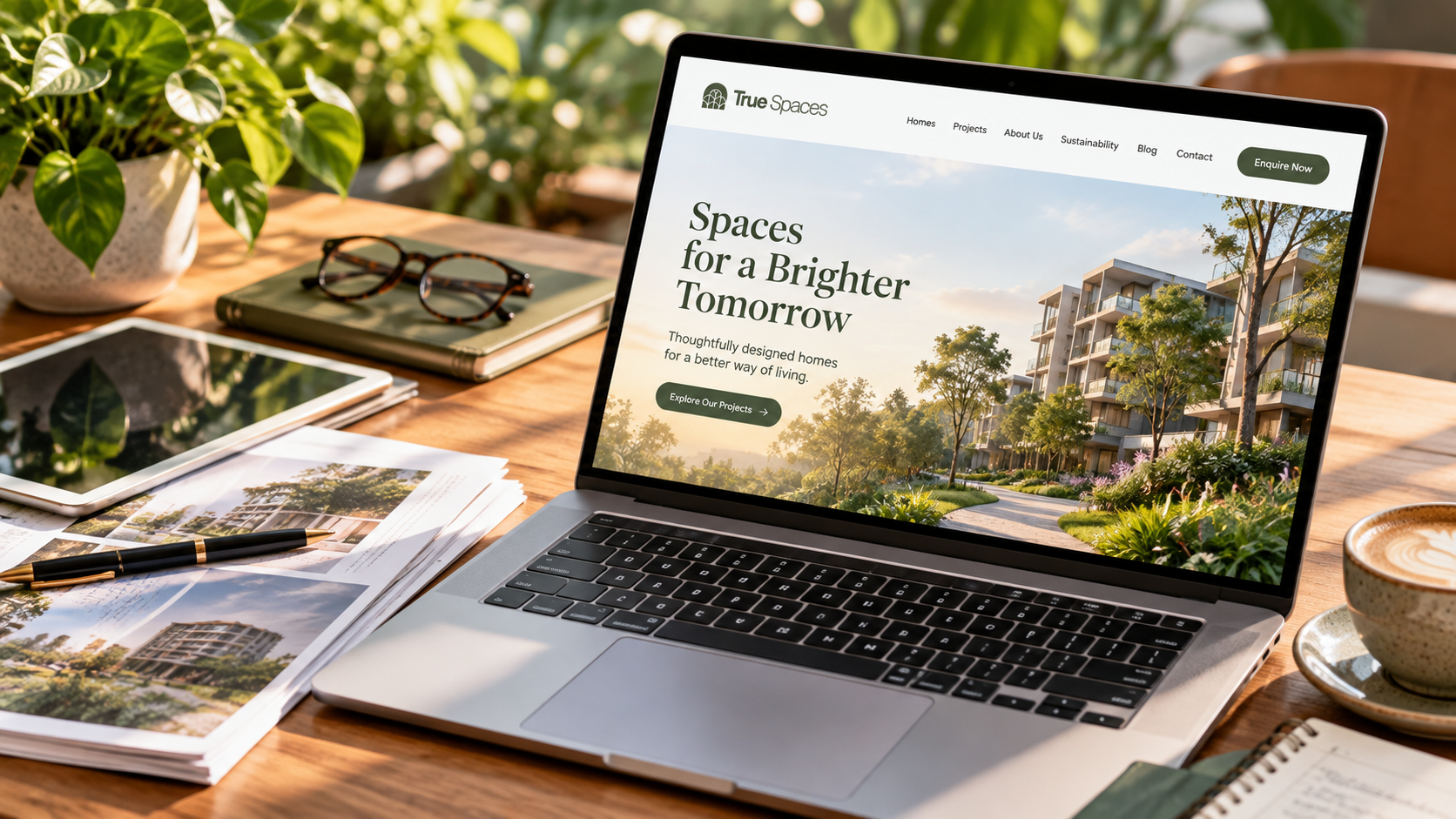
Most real estate launches begin with the media plan and treat the website as somewhere to send the traffic. We built Samridhi the other way around, because a launch website is not a brochure that happens to sit online, it is the point at which an expensive click either becomes a booked site visit or disappears for good.
This is how Digital Advantage Media conceptualised the brand and built the launch site for Samridhi, the new residential project by True Spaces, and what the decisions behind it say about digital marketing for real estate developers more broadly.
The brief
True Spaces has been designing and building in Bangalore for over 20 years, with 15+ projects delivered across homes and workspaces. The portfolio includes BOCHS Akshaya, a residence in Akshaya Nagar whose homes were taken up by bank officers from across India, and Beacon, a 15,000 sq ft G+4 mixed-use building on Akshaya Nagar Main Road that the team designed, built and leases today.
Samridhi is the next address: 2, 3 and 3.5 BHK homes beside Yelenahalli Lake in Akshaya Nagar, starting at ₹1.1 Cr, with nearly 60% of the site given to open space. The brief was to conceptualise the brand and launch the website as bookings opened.
The competitive problem was clear from the start, because a boutique developer launching in South Bangalore competes for the same search terms as builders with far larger budgets, so winning on spend was never the route. The site had to win on clarity instead, which is the same principle behind our lead cost benchmarks for Bangalore: cheaper traffic is rarely the lever, and better qualified traffic almost always is.
We started with the position, not the pixels
Before any page was designed, we worked out what Samridhi offered that nothing else in the catchment did. The answer was not amenities, because amenities are table stakes in Bangalore, and it was not price, because competing on price erodes a boutique developer's margin and its positioning at the same time. The answer was the trade-off buyers in South Bangalore are already weighing: they want to stay near the community they grew up in, and they want somewhere quieter than what the city currently offers them.
That became the line the brand runs on, which is close to the city, closer to peace. It works because it is not decoration, it names the exact tension the buyer is sitting with, so the rest of the site has something to prove rather than something to describe.
A website built before the position is settled ends up as a list of features, which gives a buyer no reason to choose you over the larger project 2 km away.
We wrote the site around what stops people from buying
Most developer websites lead with specifications, which answers questions the buyer has not asked yet. We built a section addressing the three objections that actually stall a South Bangalore purchase, under the heading that buying a home should not be this hard.
The first is pricing, where the concern is hidden costs, so the site states that what is quoted is what gets paid. The second is layouts, where the concern is one-size-fits-all planning, so the site explains that every room is planned around how a family actually lives. The third is the neighbourhood, where the concern is having to move out of South Bangalore to afford something better, so the site makes the point that a buyer can start a new chapter without leaving the community they are part of.
This does two jobs at once. Objections handled on the page are objections the sales team does not handle on a call, and the same structure gives the page genuine depth around the questions people actually type into search, which is what our landing page framework and our SEO and AEO work are both built around.
We let the site prove itself
Yelenahalli Lake sits directly beside the project, and on most developer websites a feature like that appears as a stock image with a caption. We treated it as the strongest proof point the project has, so we filmed on site and placed a 1 minute 6 second video on the page that walks the viewer through the lake, the open space and the homes in the team's own words.
Samridhi is at groundwork stage, with excavation and surveying under way, and rather than let renders do all the talking the site carries recent photographs from the plot. Showing a half-dug site runs against the instinct to present only the finished vision, and we argued for it because a buyer evaluating a boutique developer is really evaluating whether the project gets delivered. Honest performance creative tends to outperform polished creative in exactly these moments, and a page that updates is also a page that gets recrawled.
The form qualifies before the sales team calls
A real estate lead generation website earns its keep at the form, not at the hero section. The Samridhi enquiry form asks for a preferred home, with options for 2 BHK, 3 BHK, 3.5 BHK and not sure yet, so the sales team knows the budget band before the first conversation. The not sure yet option is deliberate, because removing it pushes undecided buyers to guess or abandon the form, and an early-stage buyer is still a buyer worth talking to. A short line confirming that details stay with True Spaces addresses the hesitation Indian buyers have about handing over a phone number.
Every submission is tracked through Google Tag Manager, so enquiries can be attributed back to the channel that produced them. That matters more than it sounds, because the metric that runs a developer's media budget is cost per site visit, not cost per lead, and it only exists if tracking is live before launch. The same logic drives how we approach PPC lead generation and how we set a Google Ads and Meta budget split for a launch.
The commercial side gets its own page
True Spaces builds workspaces as well as homes, so the site carries a separate page for Beacon and the managed offices the team leases to teams of 1 to 100 people. Keeping that separate was a search decision as much as a user one, because somebody searching for a 3 BHK beside a lake and somebody searching for a managed office are two different people with two different intents, and a single page serving both ranks for neither.
What this means for other developers
Nothing in the Samridhi launch required a budget advantage. The position was settled before the design, the page was built around objections instead of features, the proof was filmed on site rather than licensed, the form qualified rather than simply captured, and the questions were answered in the open. Any developer can do all of that, and most do not, which is precisely why it works.
Digital marketing for real estate developers tends to be discussed as a media question, and media is the part that is easiest to copy. The website is where the difference is actually built, because it is the only asset a developer owns outright and the only one still working after the campaign budget is spent, which is why our performance marketing and conversion rate optimisation teams work on the same brief rather than in sequence.
Digital Advantage Media is a performance marketing agency in Bangalore building launch brands, websites and lead engines for developers across South India. If you have a project coming to market, talk to us and we will tell you where the gaps are.
Frequently asked questions
What does digital marketing for real estate developers include?
Brand positioning for the project, a launch website built to convert, paid media across Google and Meta, lead qualification, and tracking that connects spend back to site visits rather than form fills. The website is the foundation, because every other channel sends traffic to it.
Why does a residential project need its own website?
A project is sold on a specific set of decisions: location, configuration, price band and timeline. A developer's corporate site is built to represent a company, so it cannot carry the depth a single project needs or rank for the project-specific searches a buyer makes.
What should a real estate launch website measure?
Form submissions are the starting point, but the metric that matters is cost per booked site visit, because a site visit is the first point at which a lead has shown real intent. Tracking has to be configured before launch for that number to exist.
Can a boutique developer compete with large builders online?
Yes, though not by outspending them. A boutique developer competes on specificity, which means a clearly defined position, honest information, visible construction progress and a website that answers questions rather than avoiding them.
How long does it take to launch a real estate website?
It depends on how much brand work is already settled. Where positioning still needs to be worked out, that stage usually takes longer than the build itself, and skipping it is the most common reason a launch site underperforms.
Looking to improve your digital presence and grow your business with a targeted marketing strategy? Get in touch with Digital Advantage today for a personalised consultation.